
Machine Learning vs. Generative AI: What SME Leaders Need to Know

Many SME leaders feel a growing pressure to "do something with AI" - but what exactly does that mean? Between buzzwords like machine learning and generative AI, it's hard to know where to start. The truth is: these aren't just tech terms - they represent distinct tools for vastly different business functions. And knowing how to use each can bring major efficiency gains.
Too many AI terms, too little clarity
Interest in artificial intelligence is high. But so is confusion. Decision-makers in small and medium enterprises want to explore automation, cost savings and digital scalability - but technical labels like "ML" and "GenAI" quickly overwhelm.
This confusion often leads to two outcomes:
- Overinvestment in the wrong solution for the problem
- Missed opportunities for easy wins through structured automation
As we outlined in our guide What Is Artificial Intelligence? A Plain-English Guide for SME Leaders, understanding the key building blocks of AI helps SME leaders act with confidence - not buzzword fatigue.
From AI terms to use cases
At S&S Technologies, we translate AI jargon into business outcomes. We help companies clarify what ML and generative AI actually are and - more importantly - how they're used in real-life processes.
By identifying the right use case for each technology, companies get:
- Workflow automation without high development costs
- AI agents that scale customer service
- ERP or ITSM integration with real-time data
- Governed automation aligned with compliance needs
Whether it's predicting when a customer will churn or generating emails that sound human, we design solutions tailored to business function, not tech trend.
Machine learning and generative AI explained
Let's break it down with everyday analogies SME leaders will recognize.
Machine Learning (ML) is like a spreadsheet with a memory.
It looks at historical data to predict or classify things. For example:
- Seeing which customers frequently cancel services (churn prediction)
- Flagging invoices that might be fraudulent based on past anomalies
ML relies on structured data and finds patterns in it - so it's best for operations, finance or logistics use cases where numbers and records dominate.
Generative AI is like a skilled assistant trained on a mountain of content.
But instead of repeating facts, it creates new content - text, images, even code. For example:
- Writing product descriptions tailored to target audiences
- Drafting polite responses to HR email requests
Generative AI works best where human-like creativity saves time - think marketing, support or internal communication.
Side by side, the two differ in the data they need and in what they produce:
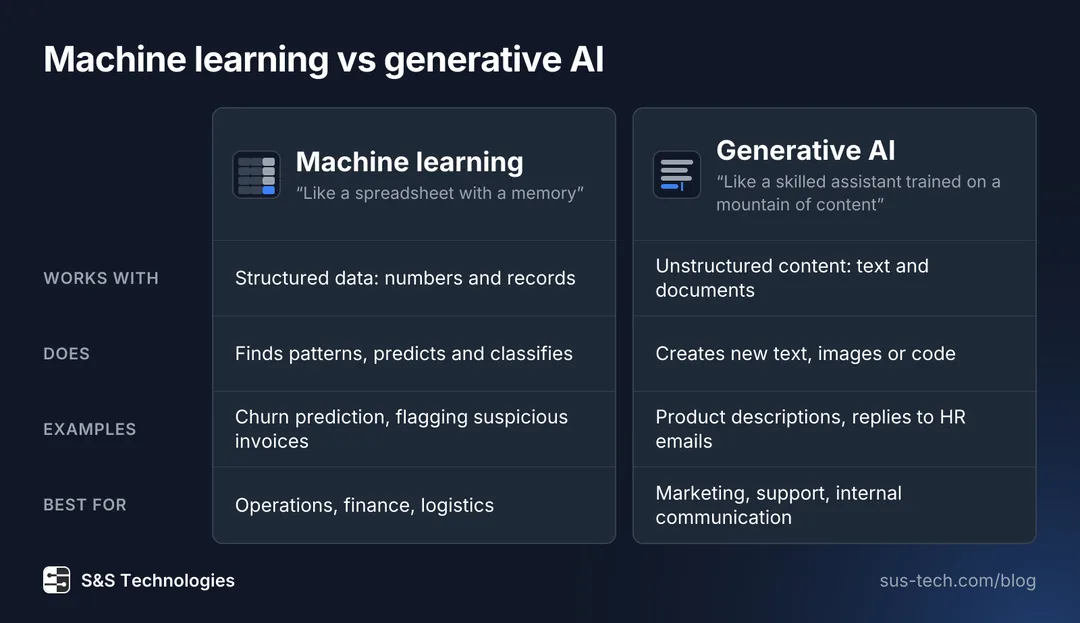
Machine learning works with structured data such as numbers and records. It finds patterns, predicts and classifies, for example which customers are likely to cancel. Generative AI works with text and documents and creates new content, for example product descriptions or replies to HR emails.
At S&S Technologies, we mainly use generative AI with workflow automation:
- Using n8n low-code tools to orchestrate flows
- Integrating AI models for ERP classification or analytics
- Deploying generative agents to write or respond on your behalf
- Applying process mining to detect where automation brings the most value
In many cases, Small Language Models (SLMs) offer capable local GenAI workflows. As described in Small Language Models (SLMs): Agentic AI for Your Workflow Automation, SLMs can handle many routine tasks at a fraction of the cloud cost - a good fit for SMEs.
Why the difference matters for investments
Understanding the difference between ML and GenAI leads to better investments and less trial-and-error.
Here's what happens when SMEs use both effectively:
- Customer Support: An AI agent that answers basic queries shortens response times
- Invoice Automation: AI agents reduce manual entry by classifying and routing invoices directly into ERP systems
- IT Service Management (ITSM): GenAI assistants can generate ticket summaries and root causes automatically, improving speed and accuracy
- Content Operations: Marketing teams save time with GenAI-generated drafts for newsletters, FAQs or product blurbs
With the right AI blend, SMEs achieve:
- Faster process cycles with fewer manual steps
- Efficiency gains across finance, HR and operations
In short: "Automate. Optimize. Scale."
Matching the method to your use case
Want to match the right AI method to your use case? Here's where to begin:
- List key business processes: Where do your team members spend the most time on routine tasks?
- Prioritize by impact: Which processes cost the most in time or error?
- Identify data types: Do you have structured data (ML) or unstructured content (GenAI)?
- Run a use case pilot: Let us help you test a quick win using n8n, generative agents or ERP-integrated ML.
The four steps at a glance, with the data type in step 3 deciding the method:
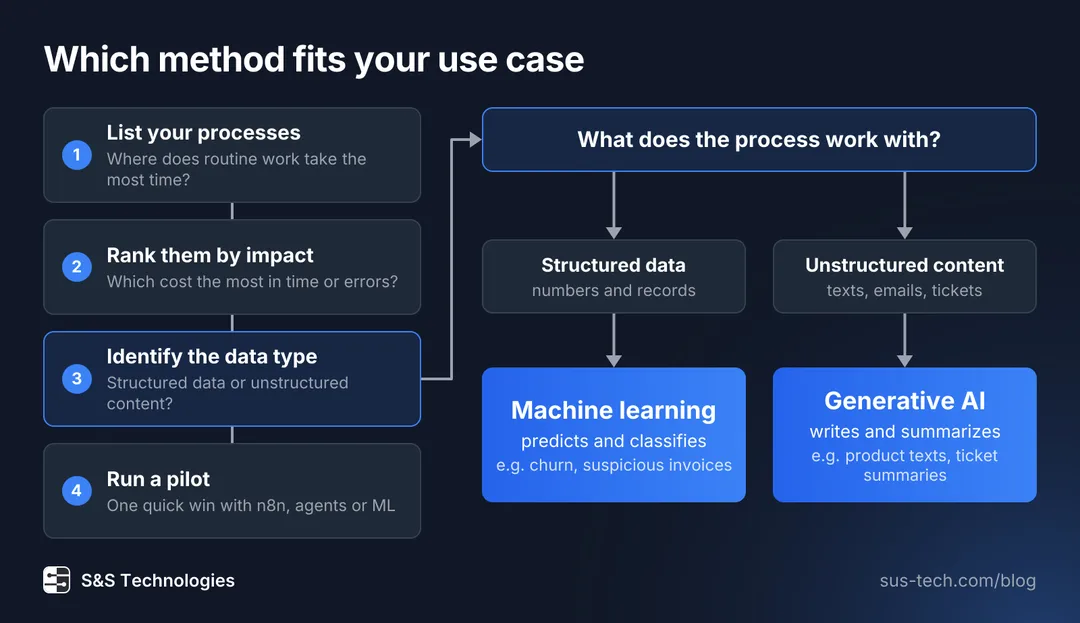
If the process works with structured data such as numbers and records, machine learning fits: it predicts and classifies. If it works with texts, emails or tickets, generative AI fits: it writes and summarizes. Either way the next step is a small pilot on one process.
Contact our team at office@sus-tech.at to explore a tailored automation roadmap.