
GPT-OSS: OpenAI's Open-Source Models That Rival Proprietary LLMs

OpenAI's launch of gpt-oss-120b and gpt-oss-20b in August 2025, its first open-weight language models since GPT-2, is a turning point for enterprise AI: businesses can deploy open-weight models that come close to OpenAI's own proprietary models - on their own terms. This opens the door to scalable, secure and compliant AI workflows running on-premise, at the edge or in private clouds.
S&S Technologies GmbH helps clients put these models to work. Let's explore what this means for your organization.
Stuck between cloud AI and compliance
Despite the surge in generative AI adoption, many enterprises feel stuck between innovation and compliance. Proprietary cloud-based LLMs come with significant challenges:
- Data residency ambiguity: Even so-called "EU-hosted APIs" may replicate telemetry or logs to non-EU locations.
- Unpredictable pricing: Per-token costs can spiral quickly, especially as demand scales.
- Integration limits: External LLMs often struggle to align with ERP workflows, security layers or ITSM environments.
- Vendor lock-in: Custom solutions remain tied to third-party APIs.
These barriers limit AI adoption and raise serious compliance risks - especially under GDPR, ISO 27001 and national data retention rules.
Open-weight models in your own infrastructure
With the release of gpt-oss-120b and gpt-oss-20b, S&S Technologies now offers clients a way to build powerful, secure AI agents - within their own ecosystem. These models deliver:
- Benchmark results close to OpenAI's own closed models: according to OpenAI, gpt-oss-120b reaches near-parity with o4-mini on core reasoning benchmarks and gpt-oss-20b delivers results similar to o3-mini (OpenAI)
- Strong results in reasoning, tool use and few-shot function calling
- Open, Apache 2.0 licensing with zero API dependency
OpenAI's model card gives the numbers behind the first point:
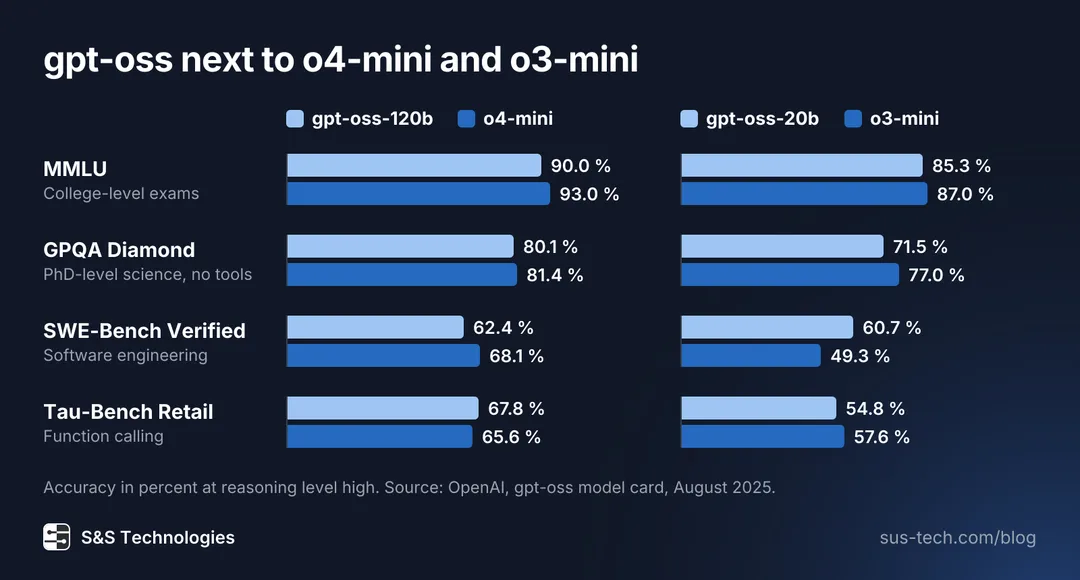
On MMLU gpt-oss-120b scores 90.0 % against 93.0 % for o4-mini, on GPQA Diamond 80.1 % against 81.4 %. In function calling on Tau-Bench Retail it is slightly ahead with 67.8 % against 65.6 %, which matters for agents that call tools. The smaller gpt-oss-20b stays close to o3-mini on MMLU (85.3 % against 87.0 %), trails it on GPQA Diamond (71.5 % against 77.0 %) and beats it on SWE-Bench Verified (60.7 % against 49.3 %). OpenAI measured all results at the highest reasoning level (model card).
We combine these open models with our expertise in GDPR-compliant LLM hosting and workflow automation tools like n8n to build governed AI services tailored to your infrastructure.
How we deploy gpt-oss
Our deployment architecture is flexible, scalable and privacy-first:
- Model selection & fine-tuning: We help you choose between gpt-oss-20b for edge use or gpt-oss-120b for heavy lifting. Both ship with MXFP4 quantization, which keeps the memory they need for local inference low.
- Deployment: Install on-premise, in EU-based data centers or hybrid environments - with Docker, Kubernetes or edge nodes.
- Workflow automation: Integrate LLMs into ERP and ITSM platforms using n8n, event listeners and policy-controlled prompts.
- Governance: Apply our AI governance layer, which includes prompt auditing, chain-of-thought (CoT) observability and safety benchmarking informed by OpenAI's Preparedness Framework.
- Custom knowledge injection: Use local vector stores to enable retrieval-augmented generation (RAG), so the models can answer from support tickets, product docs or compliance policies.
This approach mirrors key practices outlined in our comparison of RAG vs. Finetuning strategies, allowing clients to mix both for optimal control.
What companies gain
Organizations working with S&S Technologies and the gpt-oss stack can expect:
- No per-token API billing: at high volumes the hardware costs less than the API (see our cost comparison)
- Faster responses, because requests do not travel to a cloud provider
- Local processing end to end, which makes GDPR and works-council requirements easier to meet
- Tailored performance: gpt-oss-20b runs on devices with 16 GB of memory; gpt-oss-120b runs on a single 80 GB GPU (OpenAI)
- Flexible customization: full model control for domain-specific tuning or tool integration
Which of the two models fits depends mostly on the hardware you have:
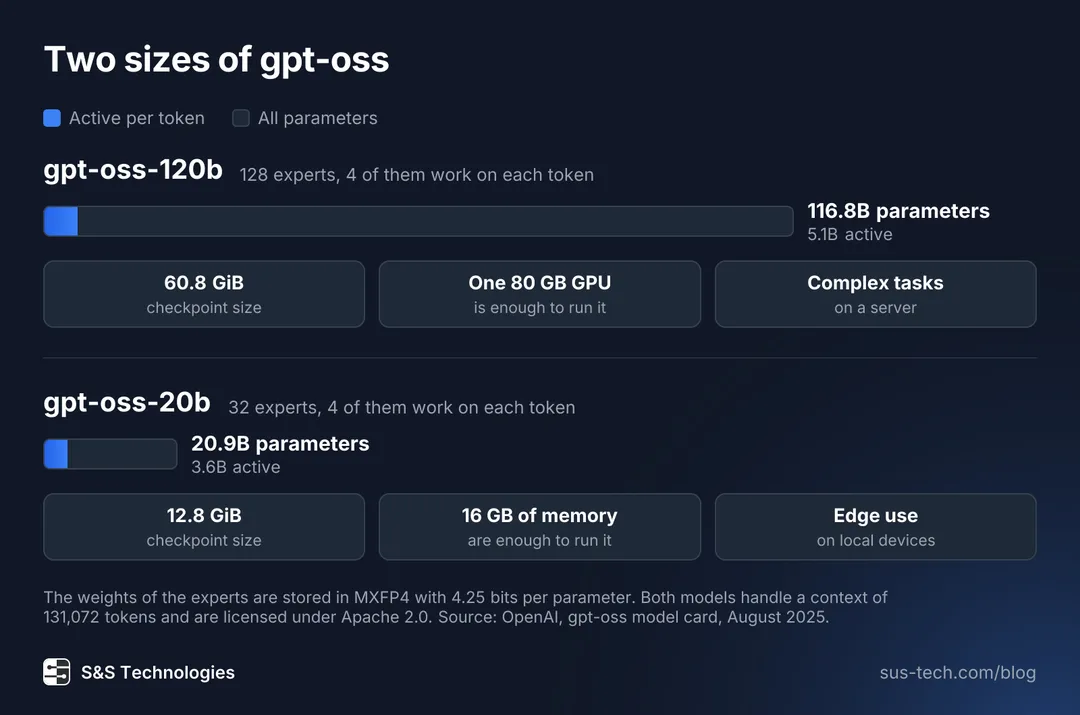
Both are mixture-of-experts models. The larger gpt-oss-120b has 116.8 billion parameters, but only 5.1 billion of them are active for each token. Its checkpoint takes 60.8 GiB and fits on a single 80 GB GPU. The smaller gpt-oss-20b has 20.9 billion parameters with 3.6 billion active. Its 12.8 GiB checkpoint runs on systems with 16 GB of memory. Both handle a context of 131,072 tokens.
These benefits add up with the agentic workflows described in Small Language Models (SLMs): Agentic AI for Your Workflow Automation.
How to try gpt-oss
Open models are no longer just academic luxuries - they are ready for production use in your workflows. Whether you're building an ITSM agent, automating GDPR reporting or enriching ERP master data, your AI stack stays under your own control.
Here's what to do next:
- Map your key AI use cases: Where are you currently reliant on external APIs?
- Assess compliance criteria: Are audit logs needed? Do prompts contain personal or IP-sensitive data?
- Run a cost analysis: count the tokens your workflows use per month and the model calls per document
- Plan for deployment: Edge? Data center? Hybrid?
- Engage an expert: Our team will draft a governed GPT-OSS deployment blueprint tailored to your business
Contact our team at office@sus-tech.at to explore how gpt-oss models fit your organization's AI strategy.
Automate. Optimize. Scale.