
Establishing Accountability: Automating Ownership Governance in Confluence

In large Confluence environments, documentation often outlives org charts. When pages stay assigned to users who have left the company or lost access, accountability disappears and governance risks quietly grow across your knowledge base.
Page ownership is a control, not an admin detail
At enterprise scale, Confluence ownership is not an admin detail, it is a control. When ownership is unclear, everyday work slows down: teams waste time finding the "right" person to approve changes, service desks struggle to route requests and subject matter experts hesitate to update content they do not own.
The risk compounds as your Confluence footprint grows across business units, geographies and programs:
- Onboarding and offboarding become documentation events: if page ownership is tied to individuals who leave, content governance breaks the moment HR changes do
- Audit-readiness weakens: compliance teams need to show who is accountable and when reviews happened, not just that a page exists
- Delivery slows: product and operations teams lose time on "who owns this?" investigations instead of shipping improvements
In regulated environments, knowledge base accountability is often a prerequisite for traceability. If you cannot identify a responsible owner for a critical procedure, policy or SOP, you are effectively depending on institutional memory, not governed automation.
Pages owned by people who have left
Confluence pages frequently remain owned by inactive accounts after role changes, departures or access removals. The result is orphaned content: pages that exist, are referenced and may even be operationally critical, yet have no reachable accountable owner.
That creates three concrete governance failures:
- No clear responsibility: updates and reviews stall because nobody can be assigned quickly
- Broken accountability chains: teams cannot prove who is responsible for content quality and approvals
- Compliance blind spots: audit questions like "who approves changes?" or "who owns this procedure?" cannot be answered reliably
Ownership gaps also correlate strongly with content decay. Pages without an active owner are more likely to become stale, inaccurate or simply forgotten. Over time, this undermines Confluence as a trusted source of truth and pushes teams back to shadow documentation in emails, PDFs and spreadsheets.
Why manual ownership reviews do not scale
Enterprises usually attempt Confluence ownership governance through a mix of good intentions and manual work:
- Manual audits performed by space admins or governance leads
- Spreadsheet-based reviews where page links are copied, filtered, assigned and chased
- Ad-hoc scripts written once, then left to break when spaces, permissions or APIs change
These approaches fail at scale for predictable reasons.
Manual checks are slow and inconsistent across spaces. Spreadsheet reviews quickly become outdated and depend on human follow-through. One-off scripts often lack consolidated reporting, error handling and long-term maintainability, especially when Confluence structures evolve or when teams need a repeatable control that can be re-run during audit preparation.
Most importantly, these methods rarely connect to onboarding and offboarding. That means ownership governance is reactive: you notice the gap only after a page becomes a problem.
The Confluence Ownership Scanner
S&S Technologies addresses this gap with the Confluence - Ownership Scanner workflow. It automatically detects Confluence pages owned by inactive users and generates a consolidated, actionable report across selected spaces.
This is governed automation: it complements existing Confluence administration by making ownership gaps visible, enabling proactive reassignment and supporting structured governance routines that can be repeated and evidenced. Automate. Optimize. Scale.
You can review the solution details here: Confluence - Ownership Scanner.
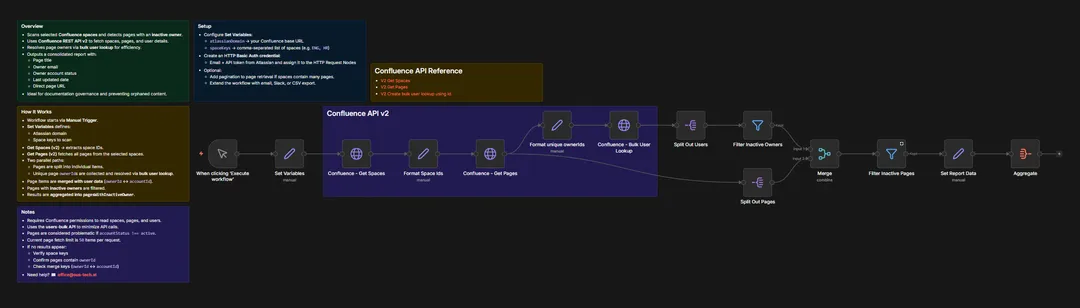
How the scanner finds orphaned pages
Architecture
The workflow is manually triggered and designed for predictable, audit-friendly execution. It scans configured Confluence spaces, retrieves spaces and pages through Confluence REST API v2, resolves page owners in bulk, then outputs a consolidated results array of pages with inactive owners.
In practice, this looks like:
- Configure Atlassian domain and target space keys
- Retrieve space identifiers, then fetch pages per space
- Resolve page ownership status efficiently using bulk lookup
- Produce a single report array for follow-up actions
This approach avoids "spot checks" and instead gives you a space-wide view that governance teams can act on.
Integrations
The solution integrates with Confluence Cloud via Confluence REST API v2, including:
- Get Spaces (v2) to enumerate relevant spaces
- Get Pages (v2) to retrieve pages from those spaces
- users-bulk API to resolve owners efficiently at enterprise scale
Optional extensions can add operational delivery and governance convenience:
- Email or Slack notifications to deliver the report
- CSV or spreadsheet export for audit attachments and review workflows
- Pagination for large spaces beyond the default fetch window
Automation and AI
The Ownership Scanner is workflow automation first: it orchestrates a consistent process without relying on manual audits.
Key automation steps include:
- Configuration via a Set Variables node (Atlassian domain and selected space keys)
- Parallel processing that splits pages into individual items while collecting unique
ownerIdvalues - Bulk user lookup to map ownership identifiers to user account objects
- Merge and filter to join page metadata with user status and flag owners where
accountStatusis not active - Aggregation into a single
pagesWithInactiveOwnerarray for reporting and downstream actions
This design enables repeatable enterprise automation. You can run it as a baseline audit, then operationalize it as a standard governance control.
Example Output:
[
  {
    "pagesWithInactiveOwner": [
      {
        "title": "Test Page",
        "ownerStatus": "inactive",
        "ownerEmail": "mail@test.com",
        "lastUpdated": "2025-12-23T12:59:56.232Z",
        "url": "https://domain.atlassian.net/wiki/spaces/PT/overview"
      },
    ]
  }
]
Security and Governance
The workflow focuses on governance visibility and traceability:
- It flags pages where
accountStatus !== active - The report includes page title, owner email, owner account status, last updated date and direct page URL
- Default page fetch limit is 50 items per request, with pagination as an optional extension for large spaces
This matters for compliance because it produces a defensible artifact: a consistent report that can be attached to internal control testing, responsibility audits and governance routines.
What clear ownership brings
Operational Efficiency
Instead of chasing ownership across org changes, teams get a consolidated report that points directly to the pages needing reassignment. That saves the most time during reorganizations and large offboarding waves, when ownership questions pile up.
For service desks, the impact is immediate: fewer tickets bounce between teams because content routing and escalation paths become clearer.
Cost Reduction
Manual ownership audits are recurring work that scales linearly with the number of spaces and pages. Automated scanning replaces periodic spreadsheet-driven reviews with a standardized output.
What changes when organizations replace manual checks with workflow automation:
- Less recurring review work for Confluence admins and space owners, work that grows with every space in larger deployments
- Fewer ad-hoc scripts to maintain and fewer last-minute "audit scramble" efforts
This is also aligned with the broader identity governance lesson: stale accounts and lifecycle gaps cost money and time when managed reactively. Our article Closing Access Gaps: The Role of Automation in Identity Governance expands on how governed automation reduces recurring administrative effort and strengthens compliance controls.
Risk and Compliance
Ownership gaps are governance gaps. When no active owner exists, it becomes difficult to prove:
- who is accountable for changes
- who approves updates
- whether content is reviewed on a defined cadence
Automated ownership scanning turns this into an explicit, trackable control. It also reduces the chance that critical documentation remains effectively "unmanaged" after personnel changes.
A key insight for compliance teams: ownership is often the prerequisite control for other documentation controls. If you cannot assign accountability, you cannot reliably enforce review cycles or remediation timelines.
Scalability
The workflow scales across multiple spaces through API-driven retrieval and bulk user resolution, so governance does not become a headcount problem.
As Confluence usage grows, the marginal admin effort stays low because the scan remains consistent:
- Same configuration pattern
- Same output schema
- Same governance logic
That is what makes it suitable as enterprise automation rather than a one-time cleanup script.
Who relies on clear ownership
This workflow is built for stakeholders who need Confluence governance to be reliable at scale:
- CIOs and IT-Ops leads who need predictable governance across collaboration platforms
- Service desk managers responsible for operational knowledge bases and ITSM automation outcomes
- CFOs who want to reduce recurring manual audit cost and governance overhead
- Compliance and risk stakeholders who require audit-ready accountability and traceability
It is also a strong fit for organizations running broader business process automation and enterprise automation programs, especially where Confluence ties into ERP integration, ITSM workflows or quality management processes.
Turning the scan into a routine
Start with a baseline, then operationalize it as a governance routine:
- Decide which Confluence space keys to include in the initial scan (start with high-risk or high-usage spaces)
- Run a baseline ownership audit to quantify orphaned content detection results and prioritize remediation
- Define a reassignment process for pages flagged with inactive owners (space admin assignment, functional owner mapping or team mailbox ownership)
- Connect governance dimensions by pairing ownership with freshness checks
That final step is where Confluence governance becomes durable.
Governance Pair: "Who owns it?" + "What needs review?"
Ownership scanning is most effective when combined with stale-content detection:
- The Ownership Scanner answers who is responsible
- The Stale Page Report answers what needs to be reviewed
Together they enable:
- Clear accountability
- Proactive documentation maintenance
- Audit-ready governance reporting
To complete the governance view, pair this workflow with our Confluence content hygiene automation: Maintaining Documentation Compliance: Automating Stale Content Detection in Confluence.
To implement the Confluence - Ownership Scanner, extend it with notifications or exports or connect it into onboarding and offboarding controls, contact our team at office@sus-tech.at.