
Closing Access Gaps: The Role of Automation in Identity Governance

Are stale accounts and unchecked permissions quietly exposing your organization to risk? Identity sprawl is costing you more than just licenses - it's compromising security.
Identity sprawl across cloud, SaaS and ERP
In most enterprises, digital infrastructures span cloud platforms, SaaS applications, ERP systems and multiple identity providers. Managing user access across these environments manually is not only inefficient - it's dangerous. Unchecked access rights can lead to over-provisioned accounts, compliance violations, data leaks and costly security breaches.
Frameworks like ISO 27001 and GDPR expect organizations to control who can access what. Security auditors expect proof of access policies, ownership and lifecycle enforcement. This makes proactive, automated identity governance a critical capability - not a nice-to-have.
How access piles up over time
Identity sprawl happens when users accumulate multiple access credentials or permissions over time, often due to role changes, department shifts or human error. Accounts for former employees may remain active and users often retain access to systems they no longer use. This leads to serious problems:
- Security risks: Over-privileged accounts give attackers more to work with. Every account that should have been removed is one more way in.
- Compliance violations: Dormant accounts and excessive access rights are red flags during audits.
- Wasted costs: Licenses tied to inactive users inflate IT spend unnecessarily.
A clear example is illustrated in our Identity Governance solution, which helps identify and resolve access inconsistencies across identity systems before they escalate.
Why spreadsheets and periodic audits fall behind
Most organizations start out with spreadsheets, periodic user audits and manual provisioning via IT tickets. Even enterprise IAM platforms can fall short if they're not fully integrated or lack policy enforcement.
Here are the common challenges:
- Manual provisioning: Time-consuming and prone to human error.
- Slow role updates: Delays in aligning access with a user's current responsibilities.
- Disconnected systems: HR changes don't propagate to IT systems automatically.
- Audits miss gaps: Sporadic compliance checks fail to catch real-time risks.
This reactive model leads to fragmented ownership, forgotten access and slow issue resolution. As highlighted in our blog post Why Data and Identity Governance Is Critical for Every Business, even small missteps can compound into costly governance failures.
The timeline shows why the moment of the check matters:
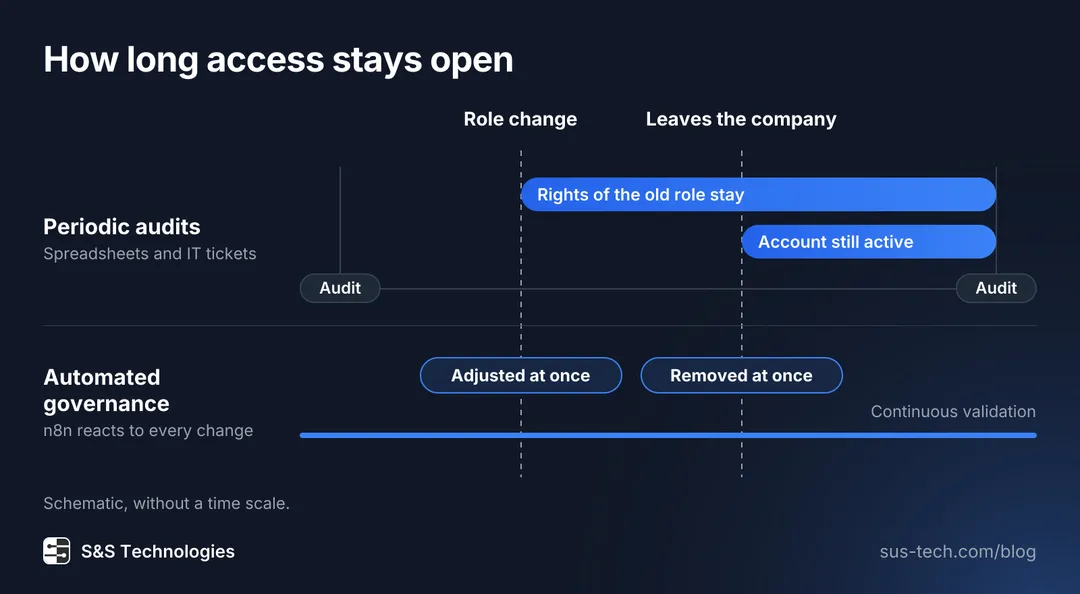
With periodic audits, the rights of an old role and the account of someone who has left stay open until the next audit at the earliest. With automated governance, access is adjusted at the role change and removed as soon as the person leaves. Continuous validation keeps checking in between.
Governance that runs with every change
At S&S Technologies, we believe identity governance should be embedded, automated and enforceable. We deliver a governed automation approach that integrates access lifecycle management directly into enterprise workflows.
Our identity governance automation ensures:
- Provisioning and deprovisioning are based on business-driven rules.
- Access updates reflect role changes instantly.
- Offboarding is immediate and complete.
- Policies are consistently enforced across systems.
By applying automation through tools like n8n, we create reusable workflows to manage identities proactively - from onboarding to offboarding - with full visibility and control. Automate. Optimize. Scale.
How automated identity governance works
Architecture
Our identity governance solution implements orchestrated, policy-driven workflows in n8n. It continuously monitors connected systems, reacting to lifecycle events like role changes or contract endings. It ensures every identity follows approved access patterns and leaves no access trails behind when users exit.
Integrations
We connect to major identity providers, HR platforms and business systems via APIs. This includes:
- Microsoft Entra ID (Azure AD)
- On-premises Active Directory
- HR/ERP systems
- Collaboration tools like Confluence and SharePoint
When a user's employment status or role changes in the HR system, access adjustments trigger instantly across all enrolled platforms.
The diagram shows this for the three events of the identity lifecycle, often called joiner, mover and leaver:
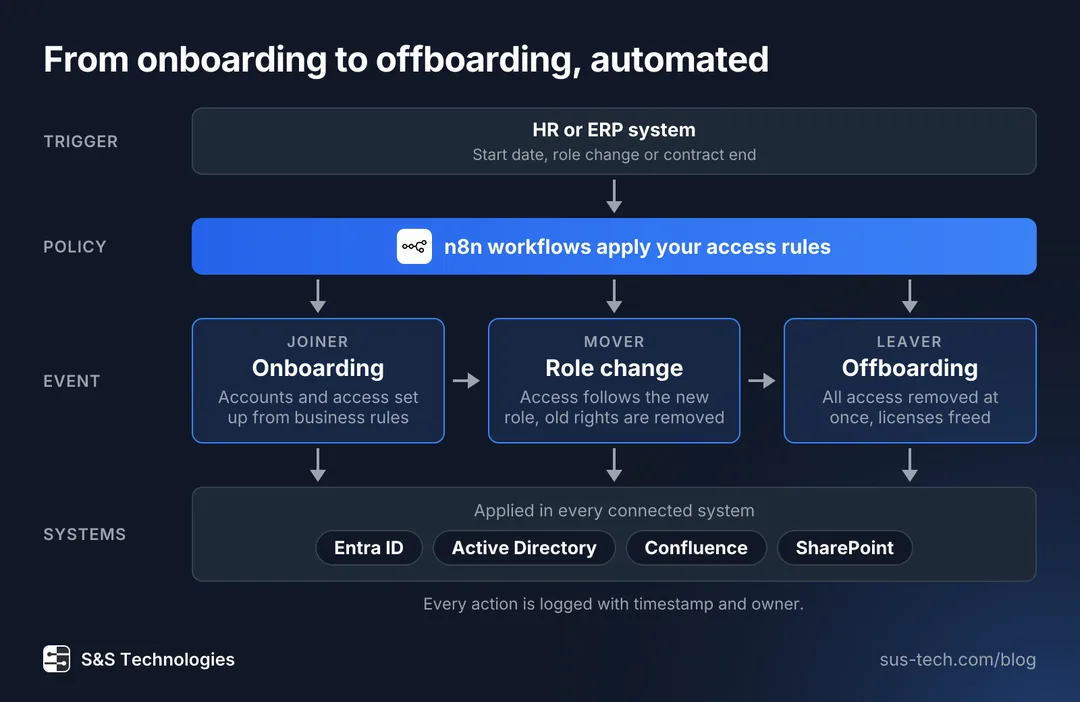
A start date, a role change or a contract end in the HR or ERP system starts an n8n workflow that applies your access rules. New hires get accounts and access based on business rules. After a role change, access follows the new role and the rights of the old one are removed. At offboarding all access is removed at once and licenses are freed. Each change is applied in Entra ID, Active Directory, Confluence and SharePoint. Every action is logged with a timestamp and owner.
Automation and AI
Repetitive identity tasks - like cleaning up stale accounts or provisioning new hires - are fully automated. AI agents assist with:
- Suggesting actions based on role analytics
- Identifying anomalous access patterns
- Proposing ownership reassignments for orphaned resources
For instance, our Confluence - Ownership Scanner automatically scans pages to identify inactive owners, enabling teams to reassign responsibility so that every page has an owner.
Security and governance
All workflows log every action with timestamps and ownership information. Governance policies define allowed actions, keep users within "least privilege" boundaries and ensure that audits are always backed by traceable records. This helps with the access controls that ISO 27001 and GDPR call for.
What automation changes for security and IT
Operational efficiency
By eliminating manual identity tasks, teams win back time and reduce service delays. Automated workflows ensure:
- Faster user onboarding/offboarding
- Immediate access role updates
- Real-time compliance reporting
Automation takes these recurring tasks off the IT team.
Cost reduction
Inactive accounts are detected and deprovisioned promptly, reclaiming unused licenses. Every license freed by removing redundant access lowers the SaaS bill.
Risk and compliance
Risks like orphaned accounts and over-permissioned users are closed before an audit finds them. Continuous validation ensures access remains aligned with active organizational roles.
Scalability
As organizations grow - organically or through M&A - identity governance scales without adding headcount. Our workflows are not tied to one platform and grow with the number of identities you manage.
Where it fits
Our identity governance automation is ideal for:
- CIOs focused on long-term business resilience
- CISOs and Compliance Officers seeking audit-ready controls
- IT-Ops Leaders aiming to reduce help desk overhead
- IAM Teams needing consistent access enforcement across systems
Whether your enterprise is expanding cloud adoption or facing stricter compliance mandates, governed identity automation keeps access under control.
Where to start
Governance isn't just a checkbox - it's how enterprises stay secure, efficient and compliant. Don't wait for audit failures or security incidents to act.
Start here:
- Evaluate identity lifecycle gaps in your current operations.
- Identify high-risk areas - e.g., dormant accounts, inconsistent offboarding.
- Ask our governance team to design automation that fits your environment.
Contact our team at office@sus-tech.at to plan governed identity lifecycle management for your environment.