
Why Data and Identity Governance Is Critical for Every Business - and Why Starting Early Matters

Uncontrolled access and fragmented identity management can turn even small operational oversights into costly breaches. Are you building your business on a secure governance foundation?
Growth brings more users, tools and data
Organizations of all sizes increasingly rely on digital collaboration platforms and distributed teams. With that growth comes the need for clearly managed user access, content ownership and data usage policies. Gaps in governance don't just impact security - they also slow operations, raise compliance risks and increase IT workload.
As systems grow more complex, unmanaged access can turn into orphaned accounts, dubious permissions and unclear responsibilities. These slowly accumulating inefficiencies create a fragile foundation. Ultimately, what starts as small governance omissions can lead to failed audits, unresolved access reviews and expensive, manual cleanup.
Data and identity governance are no longer just concerns for enterprise-scale businesses - they're essential at every stage.
What happens without governance
Modern organizations typically add users, tools and systems at a rapid pace. Over time, this leads to:
- Outdated permissions and unmanaged accounts
- Scattered data ownership with no accountability
- Security blind spots from forgotten public shares or old roles
- Manual processes for provisioning and audits that don't scale
For example, Confluence pages authored by users who've left the company still remain accessible, leaving knowledge unowned. Without regular access review, SharePoint files shared with external users could persist unnoticed for years. Identity systems may lack lifecycle controls, so former staff retain access well beyond their last day. These issues compound as teams grow and systems integrate, making remediation more difficult and costlier over time.
Why informal processes stop working
Initially, many teams handle access and content ownership through informal processes. They might:
- Track permissions in spreadsheets
- Rely on individual teams for cleanup
- Perform periodic audits manually
- Handle provisioning on a case-by-case basis
While workable for five users and two systems, these methods quickly crumble under scale. Manual processes are error-prone and time-intensive. Disconnected tools offer no centralized visibility. Even large enterprises get caught off guard. As our article The Cost of Doing Nothing: Hidden Inefficiencies in Legacy Workflows shows, relying on outdated or informal practices drains efficiency and hides escalating risk.
Each of these informal habits has an automated counterpart:
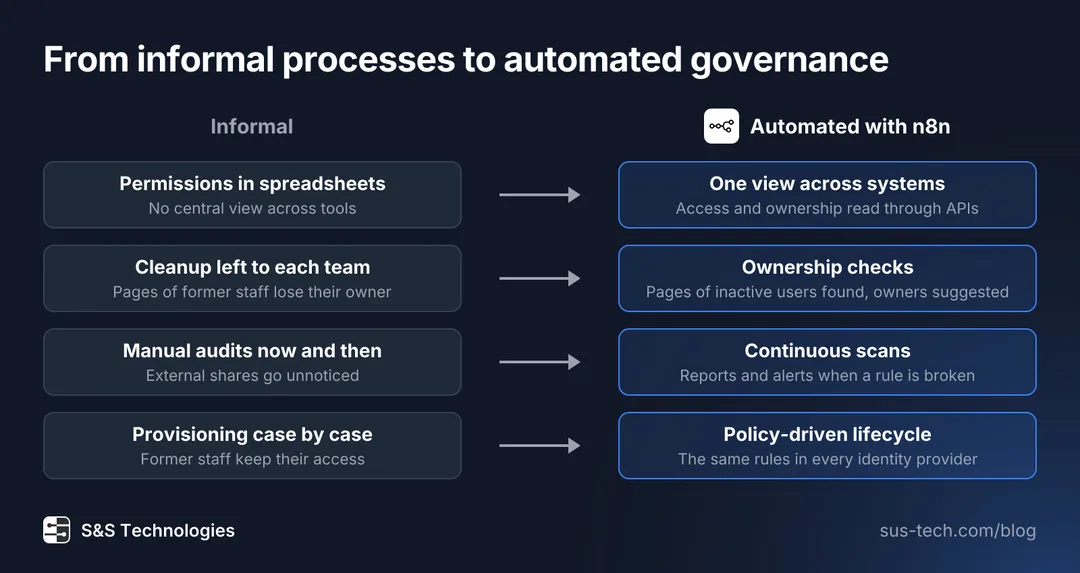
Spreadsheets give way to one view of access across all systems. Instead of relying on each team to clean up, ownership checks find pages of inactive users and suggest new owners. Continuous scans with reports and alerts replace the occasional manual audit. Provisioning follows the same lifecycle rules in every identity provider instead of being decided case by case.
Governance from the start
At S&S Technologies, our approach to governance is proactive, automated and transparent. We help businesses embed identity and data governance early - before their systems grow complex.
We offer pre-built and customizable governance solutions for:
- Confluence Automation Suite: Ensures clarity of ownership and access across your Confluence spaces.
- SharePoint Automation Suite: Securely manages external sharing and access governance in Microsoft environments.
- Identity Governance: Creates consistent, policy-driven user lifecycle processes across identity providers.
All solutions are governed workflows built with n8n to enforce policies, reduce manual work and provide audit-ready transparency from day one. Automate. Optimize. Scale.
What early governance looks like in practice
Architecture
Our workflows are configuration-driven and built in n8n. We connect to key systems via APIs including Microsoft Graph, Atlassian REST v2 and GraphQL. Workflows enforce rules like inactive user detection or public link audits in real time.
For example, our Confluence - Ownership Scanner identifies pages owned by inactive users, delivering clear action-ready reports that support ownership reassignment.
The diagram shows how the parts fit together, from the connected systems to the results:
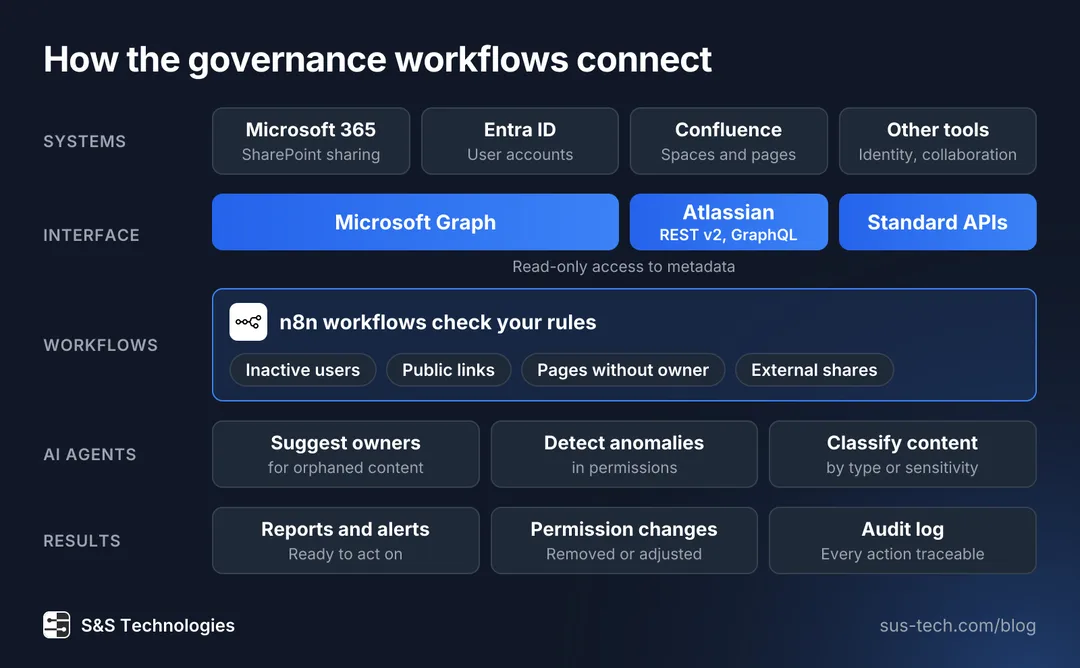
Microsoft Graph connects Microsoft 365 and Entra ID. Confluence is reached through the Atlassian REST v2 and GraphQL APIs, other tools through their standard APIs. The workflows read metadata and check rules such as inactive users, public links, pages without an owner and external shares. AI agents suggest owners for orphaned content, detect permission anomalies and classify content. The results are reports and alerts, permission changes and entries in the audit log.
Integrations
We support integrations across your existing platforms:
- Microsoft 365
- Atlassian Confluence
- Microsoft Entra ID
- Other identity and collaboration tools via standard APIs
This gives full visibility and policy enforcement, even in complex IT environments.
Automation and AI
Governed automation runs governance checks continuously instead of by hand. With n8n, we create flows that:
- Scan content for compliance risks
- Generate reports or notifications
- Remove or adjust permissions
We also incorporate AI agents to assist with:
- Suggesting ownership for orphaned content
- Detecting permission anomalies
- Classifying content by type or sensitivity
The AI agents prepare these decisions, so people can make them faster.
Security and governance
Our solutions are designed with enterprise security in mind:
- Read-only metadata access ensures sensitive content remains untouched
- Audit logs and version control support compliance
- Fully customer-owned automation means no black-box dependencies
Whether for internal audits or external regulators, every action is traceable, explainable and governed.
Why starting early pays off
Operational efficiency
Automating audits, ownership checks and access reviews cuts the time spent on manual reviews. Onboarding and offboarding become smoother and more consistent.
Cost reduction
Governance automation helps organizations avoid costly compliance violations, eliminate recurring manual tasks and cut down on IT overhead. Why these costs matter more than they seem is explained in "The Cost of Doing Nothing".
Risk and compliance
Proactive governance minimizes risks from over-permissioned accounts or shared data. Continuous scanning and enforcement reduce threat exposure and help avoid audit findings, especially in regulated industries.
Scalability
Our workflows help you avoid growing your IT team at the same rate as your business. Governance rules scale alongside your user base, platforms and org structure - keeping control intact at any size.
Who should start now
These solutions are ideal for:
- CIOs looking to standardize systems access and data management
- IT-Ops leads needing sustainable, auditable governance processes
- CISOs and compliance officers seeking risk reduction and policy enforcement
- Service desk managers who want to automate user lifecycle tasks
Whether you're managing a fast-growing SME or a complex enterprise IT landscape, governed automation keeps access and data under control as you grow.
First steps
Start secure, stay secure. Don't let governance gaps cost you time, money or trust down the road.
To take the first step:
- Identify a governance pain point - e.g., Confluence ownership, external SharePoint sharing or identity provisioning.
- Reach out to the S&S Technologies team.
Contact our team at office@sus-tech.at