
Maintaining Documentation Compliance: Automating Stale Content Detection in Confluence

Is your Confluence acting as your single source of truth - or a hidden compliance risk?
Outdated documentation is a compliance risk
For enterprises operating in regulated industries, maintaining documentation accuracy is not a preference - it's a legal and operational necessity. Outdated or inconsistent Confluence pages can lead to misinformed operations, audit failures and exposure to compliance liabilities.
In environments like pharmaceutical manufacturing, banking or energy, incomplete or stale documentation can invalidate processes or even breach regulatory requirements. Scaling documentation compliance across departments, countries and business units becomes impossible through manual effort alone.
Unaddressed, these governance blind spots don't just jeopardize audits - they erode operational trust in the platform meant to serve as the single source of truth. That's why automated Confluence governance is now an essential enterprise capability - not a nice-to-have.
How Confluence fills up with stale pages
Large enterprise Confluence environments commonly accumulate content that no longer reflects current realities: deprecated SOPs, posts by departed employees or pages orphaned by reorganizations. These stale pages mislead users, introduce process inconsistency and weaken compliance postures.
Manual review approaches often consist of:
- Periodic auditing campaigns
- Ad-hoc cleanups by well-intentioned team leads
- Informal reliance on authors to update their own content
This results in:
- Lack of accountability - no one knows who owns the content
- Inconsistent reporting - different methods across departments
- Missed timelines - stale pages remain undetected for months
As noted in Why Data and Identity Governance Is Critical for Every Business, fragmented governance approaches make even small inefficiencies scale into major risk. In the case of documentation, what starts as a few unused pages can balloon into systemic non-compliance.
Why content hygiene gets left behind
Content hygiene in Confluence is often treated as an afterthought. Most organizations rely on a patchwork of approaches:
- Managers call for quarterly reviews
- Team spaces are expected to self-govern
- Some admins run manual scripts
These strategies fall short at scale for several reasons:
- No unified view: Outdated pages across spaces go unnoticed
- No clear ownership: Content can't be updated if no one is responsible
- No automation: Scripts are brittle, manual merges are error-prone
- No audit trail: No proof of documentation completeness during audits
This reactive model doesn't support the documentation compliance increasingly required by frameworks like ISO, FDA 21 CFR Part 11 or internal QA policies. It transforms Confluence from a knowledge asset into a shadow risk.
The Confluence Stale Page Report
To solve this at scale, S&S Technologies offers the Confluence - Stale Page Report: a fully automated, reusable workflow that identifies stale content across Confluence spaces.
Rather than displacing Confluence, it enhances its governance capabilities with governed automation using n8n. The workflow proactively scans pages and generates reports on outdated content - enabling structured audits, clear ownership reviews and policy-based content cleanup.
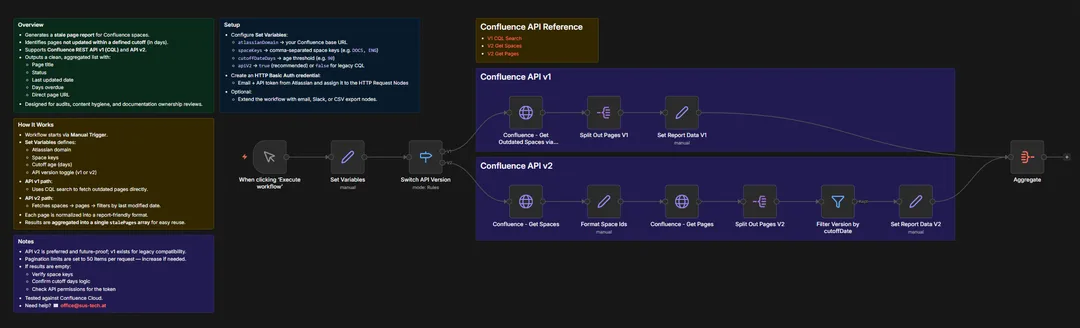
This approach transforms Confluence from a static documentation pool to a dynamic, compliant knowledge base.
How the report finds stale content
Architecture
The solution is built on a modular, event-driven n8n automation workflow. It compiles Confluence metadata into a normalized stalePages array, reporting any page that exceeds a set age threshold since last modification.
It's designed to be robust across environments, offering support for both API v1 and v2 and dynamically adaptable through variable configuration.
Integrations
Key integrations include:
- Confluence Cloud REST API (v1 via CQL or v2 paging)
- Email or Slack notifications for report delivery
- Optional CSV export for offline reviews or audit attachments
With optional cron scheduling, the workflow can run on a recurring basis - ensuring continuous visibility into documentation health.
Automation and AI
The workflow is powered by parameterized automation, not AI agents - delivering predictable, audit-safe behavior. Through a single Set Variable node, admins can adjust:
- Targeted Confluence spaces
- Update cutoff thresholds (e.g. 180 days)
- API version usage
Example Output:
[
  {
    "stalePages": [
      {
        "title": "title1",
        "status": "current",
        "lastUpdated": "2025-12-23T12:59:56.232Z",
        "daysOverCutoff": "7",
        "url": "***"
      },
      {
        "title": "title2",
        "status": "current",
        "lastUpdated": "2025-12-25T11:24:13.322Z",
        "daysOverCutoff": "5",
        "url": "***"
      },
      {
        "title": "title3",
        "status": "current",
        "lastUpdated": "2025-12-25T11:19:35.470Z",
        "daysOverCutoff": "5",
        "url": "***"
      }
    ]
  }
]
The resulting JSON report includes:
- Page title
- Last updated date
- Days since cutoff
- Page status
- URL
Designed for both human and machine use, the report can feed into dashboards, ownership trackers or audit scripts.
Security and Governance
The automation only requires read-only API access and runs using HTTP Basic Auth with email and API token. No page content is changed. All executions are logged within n8n's secure history - ensuring traceability for governance teams and internal audits.
This model meets the demands of regulated environments by:
- Avoiding privileged operations
- Maintaining audit-friendly execution trails
- Enabling internal control testing and transparency
What regular checks bring
Operational Efficiency
By automatically identifying stale content, documentation reviews get shorter: teams get targeted insights rather than wading through all pages manually.
Cost Reduction
Eliminating manual review efforts saves countless hours across quality, IT and operations departments. These reclaimed resources can be redirected to higher-value compliance tasks.
Risk and Compliance
Proactively surfacing stale documentation enables better audit outcomes, especially when demonstrating:
- Confluence documentation traceability
- Version validity
- Timeliness of procedural updates
In short, it transforms documentation compliance from an afterthought into a maintained discipline.
Scalability
As enterprises grow, Confluence spaces multiply. This workflow scales horizontally - across spaces, business units or geographies - without increasing governance headcount.
Who should run it
This solution is ideal for:
- IT Operations Leaders managing Confluence at scale
- Compliance Officers demonstrating documentation controls
- Documentation Managers tasked with oversight
- Governance Teams ensuring audit readiness
If you're responsible for keeping internal knowledge authoritative and audit-compliant, this workflow is built for you.
Making documentation hygiene a routine
Manual Confluence reviews don't scale. Ignoring documentation hygiene creates compliance liabilities. Automated stale content detection is a foundational capability for documented governance.
It's time to bring your Confluence into compliance - with automation employees won't ignore and auditors will applaud.
Contact our team at office@sus-tech.at to implement or customize stale content detection for your environment.