
n8n vs Make: Choosing the Right Automation Engine

IT-Ops leaders love drag-and-drop automation - until the bill, the audit and the AI roadmap land on the same desk. When every additional operation or task costs extra, cloud limits collide with growth. Here's how self-hosted n8n beats Make (and Zapier) on cost, compliance and local AI extensibility.
Where Make gets expensive and risky
1. Hidden licence & usage costs
- Make charges for every module run in a scenario, billed as credits. Even a simple three-step flow can burn through thousands of credits each day. Core starts at $9 a month for 10 000 credits with annual billing but scales quickly; Teams is $29 and Enterprise is custom pricing (Make pricing, October 2026) - all still per credit.
- Zapier prices per task: $29.99 a month for 750 tasks and $733.50 for 100 000 tasks on the Professional plan with monthly billing (Zapier pricing, October 2026) - plus surcharges when you exceed the cap. Our Zapier cost teardown shows how quickly it escalates.
- n8n Cloud starts at €20 a month for 2 500 workflow executions with annual billing (n8n pricing, October 2026) - unlimited steps, no premium nodes - or run the community edition free on your own server using n8n.
How differently the platforms count shows in a single run that adds five new emails to a spreadsheet:
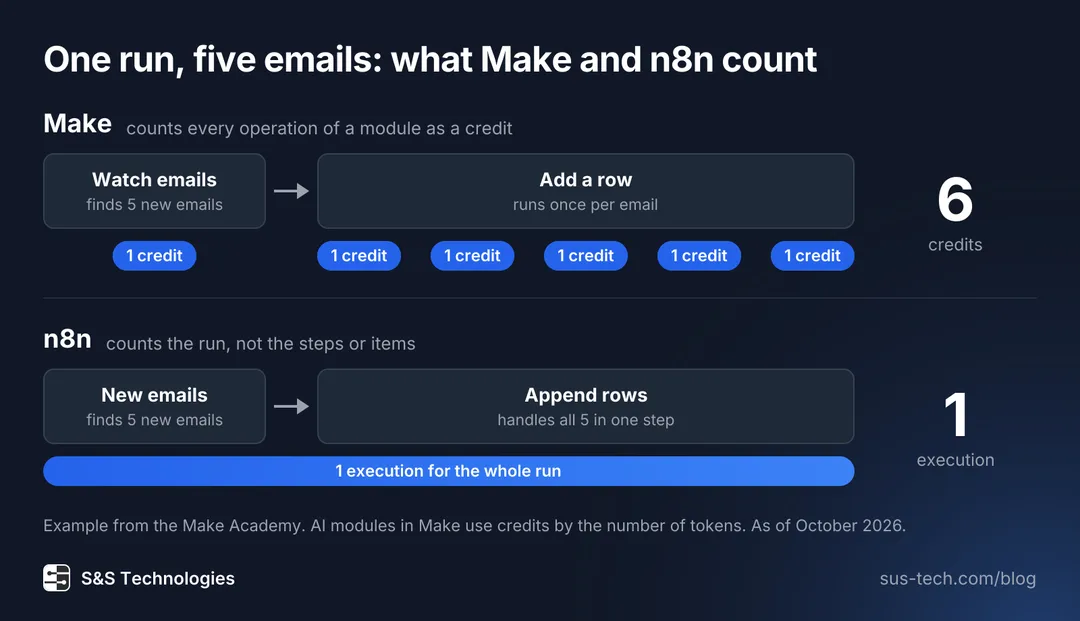
Make counts one credit for the trigger and one for every operation of a module, so the five rows use five more credits, six in total (Make Academy). n8n counts the whole run as one execution, however many steps or items it handles (n8n pricing). In Make every item that passes through a loop adds credits. In n8n it adds nothing to the count.
2. GDPR exposure
Zapier processes data on U.S. infrastructure. Make offers EU hosting, but like Zapier it is a cloud service with its own sub-processors and retention clauses. Data transfers, opaque sub-processor chains and retention rules turn every webhook into a compliance question, as we detail in our GDPR-safe local hosting guide.
Where a platform can run decides where your data is processed:
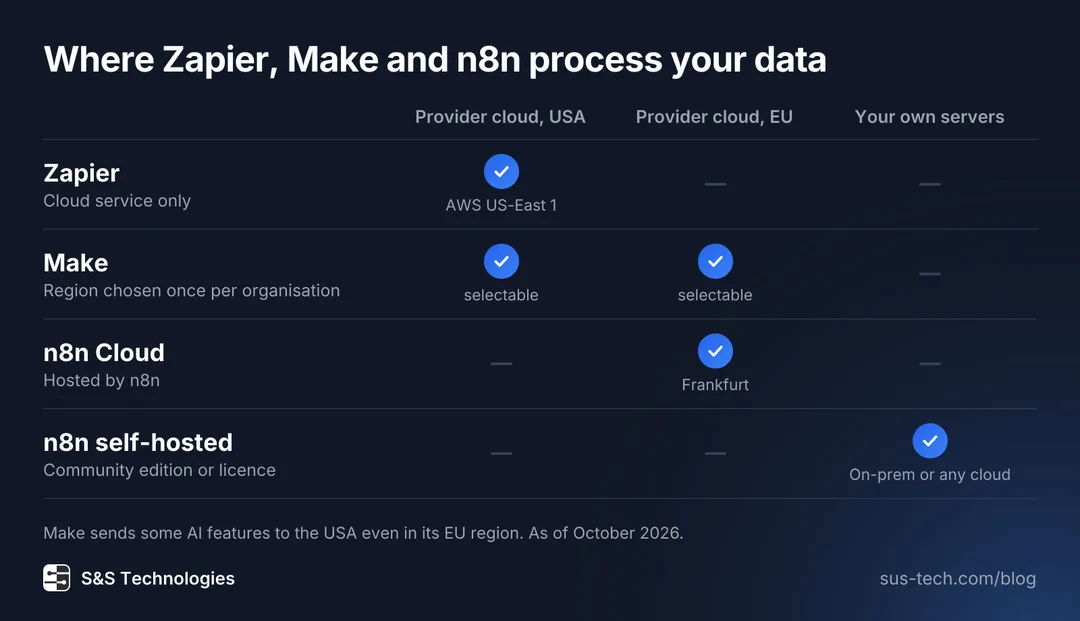
Zapier stores customer data on AWS in the USA (Zapier). Make lets each organisation choose a data centre in the USA or the EU, which cannot be changed later (Make help). A few of its AI features always send their requests to the USA (Make help). n8n Cloud stores data in Frankfurt (n8n pricing) and the self-hosted edition runs wherever you install it.
3. Limited AI extensibility
Connecting GPT APIs means double billing (automation + tokens) and shipping sensitive payloads off-prem. Token fees grow with every document and every agent step - see the numbers in our cloud vs local LLM cost comparison.
The alternative: self-hosted n8n with local models
- Self-host anywhere. Deploy n8n on-prem or in an EU cloud for full data residency.
- Run local SLMs via Ollama. Follow our guide to put a 7 B model behind
http://localhost:11434and give n8n a native AI node - no external calls. - Matrix42 connector. S&S maintains the Matrix42 node for n8n so you can raise, enrich and close tickets without scripting.
- Governance. Depending on the plan, roles, workflow history, version control with Git and log streaming help with audits (n8n pricing).
Setting up n8n and Ollama
Spin-up in minutes
# on a server with Node.js 22 and enough RAM or GPU memory for the model
npx n8n # starts n8n on port 5678
curl -fsSL https://ollama.com/install.sh | sh # installs Ollama
ollama pull gemma2:9b # downloads Gemma 2 with 9B parameters (5.4 GB)
Point the Ollama Model node at http://localhost:11434 - that's it.
Side-by-side cost demo
- Automation platform (prices as of October 2026)
- Zapier Professional (2 000 tasks): $49/mo with annual billing
- Make Core (10 000 credits): $9/mo with annual billing, but spikes with loops
- n8n self-host: €0 (plus the cost of a server)
- AI inference
- Cloud GPT-4 Turbo, agent with five calls per invoice: about $175 a month for 1 200 invoices
- Local SLM on an RTX 3060: a few cents of electricity per run after a €1 800 workstation - see the calculation
Net result: with high volumes or agents that call the model several times per document, n8n with local SLMs replaces per-operation and per-token fees with a fixed cost for hardware.
What the switch saves
- Shorter cycle times and fewer manual touches in service-desk workflows
- Less rework once ERP and ITSM loops are fully automated.
- AI costs that stay flat as volume grows; at high volumes a €1 800 AI workstation pays for itself within months, as shown in the cost comparison.
- Simpler GDPR compliance: when n8n and the model run on your own servers, the data stays there and your Article 30 records list fewer external recipients and no transfers to third countries - see our post on GDPR-safe hosting.
How to plan the move
- Audit current spend. Export usage from Zapier/Make and OpenAI; flag high-volume flows.
- Pilot locally. Follow our Ollama + n8n quick-start on a spare workstation.
- Extend with Matrix42. Install the Matrix42 node with
npm install n8n-nodes-matrix42and connect your ITSM system to your AI agents. - Measure. Compare cycle times and manual touches before and after the switch, for example from the ticket history.
- Scale. Add fine-tuned SLMs, RBAC tiers and dashboards.
Ready to cut costs, keep control of your data and automate more? Contact our team.
Automate. Optimize. Scale.